
Start a Cabell County Residents Directory Search
Begin with the kind of clue available. A street address points first to the Cabell County Assessor's maps, while a property owner's name may lead directly to the County Clerk's instrument index. A full name and date of birth can be tested in the official West Virginia voter-status lookup. A name tied to a lawsuit belongs in the state court systems. An older address or surname calls for the Cabell County Public Library, West Virginia Archives, census schedules, or a dated Huntington directory.
The rolls overlap, but each describes a different relationship. An assessor entry concerns a parcel; a taxpayer may be a mailing recipient; a deed names parties to a transfer; voter data reflects a registration entry; and a directory is a snapshot from one publication year. Renters and people who do not register to vote can be absent. A Cabell County directory search is strongest when two independent sources agree on the same name, place, and time.
- Write down the exact name, address, date range, and community label already known.
- Check the Cabell County Assessor for parcel geography and the current assessment relationship.
- Use the County Clerk index for deeds, liens, estates, marriages, and other named instruments.
- Check the official voter or court portal only when that record type answers the question.
- Move to the library, archives, or a narrow West Virginia FOIA request when the web index stops.
Parcel Clues in Cabell County Records
The Assessor's tax-map index organizes map sheets by district and map number. It includes Barboursville, Grant, Guyandotte, Gideon, Huntington Guyandotte, Kyle, Mc Comas, Milton, and Union labels. Current and prior-year sheets help keep a parcel stable when a mailing address, street label, or owner name has changed. The maps are assessment products, not surveys, and do not guarantee title, occupancy, or exact boundary location.
A sample Kyle District sheet shows parcel numbers, original lots, roads, rights-of-way, water, rail lines, and government boundaries. Those fields orient a search; the recorded deed supplies the better title trail. The Cabell County street directory gives the full address-first sequence.
The Cabell County tax-map page shows how district and map sheets are presented to the public.
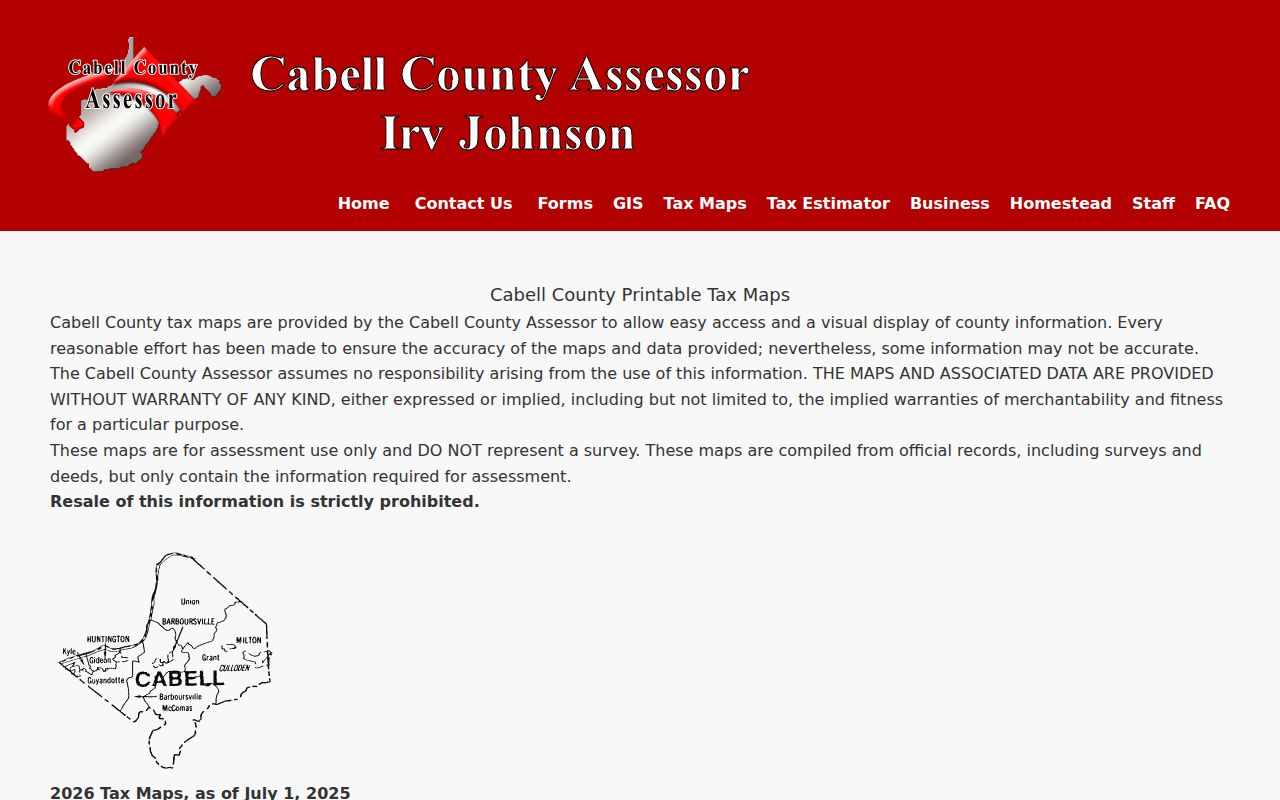
The captured index is an entry point to parcel context; the sheet disclaimer and a recorded instrument still control how its clues should be read.
Custodians for Cabell County Resident Records
Three courthouse functions form the practical core of Cabell County directory research. The County Clerk keeps the recorded-instrument index and is also the local contact for election and marriage questions. The Assessor maps and values parcels. The Circuit Clerk handles Cabell County's Sixth Judicial Circuit files. These offices can explain an index flag, locate a record not exposed online, and state the procedure for a copy.
Search Cabell County Record Roles
The Cabell County Clerk public index is the broadest local name tool because categories include deeds, liens, estates, UCC filings, miscellaneous instruments, births, marriages, and deaths. A search can use From and Thru dates, Starts With or Exact name mode, quick categories, Book and Page, Instrument, Description, or Date Range. The portal also separates legal roles, which helps prevent a misleading match.
| Index control | Cabell County question | Limit to keep |
|---|---|---|
| Grantor / Grantee | Who transferred or received an interest? | A named party is not always an occupant. |
| Creditor / Debtor | Who appears in a lien or UCC index? | The filing concerns an obligation, not residence. |
| Deceased / Infant | Is there a probate or historical vital lead? | Underlying material may be restricted. |
| Book / Page or Instrument | Can a known citation find the exact entry? | Index coverage and images vary. |
Results may display date, document, book and page, pages, name, cross date, and instrument. Save the query and access date. The landing page permits a starting date of 1900, but no official statement says every category or image reaches that far. Older volumes, missing images, and restricted records require the clerk or archives.
Present-Day Cabell County Directory Sources
No official source claims to enumerate every Cabell County resident. Instead, current directory work compares lists created for ownership, tax, voting, courts, public service, or civic participation. Each has a named keeper and a limited meaning.
| Cabell source | Relationship shown | Keeper | Public route |
|---|---|---|---|
| Parcel maps and assessment data | Parcel identifier and assessment relationship | County Assessor | Maps, GIS, or office |
| Property tax account | Taxpayer, ticket, year, and paid status | County Sheriff | Portal or 304-526-8672 |
| Recorded instruments | Party and role on a dated filing | County Clerk | Index, office, or copy request |
| Voter status | Status, party, districts, polling place | SOS and County Clerk | Lookup or statutory request |
| Court docket | Party role in a public case | WV Judiciary | Portal or clerk |
| Neighborhood contact | Public civic role or meeting route | City or association | Published group page |
For one named person, start with the source most likely to contain the known clue, then use the Cabell County resident lookup workflow to avoid merging unrelated people with the same name.
Voter Limits in Cabell County Records
The official West Virginia voter lookup asks for first name, last name, and date of birth. A result can show status, party, districts, and polling place. The site says it is informational, uses the most recent county entry, and updates nightly. It is a status tool, not an address-history file.
West Virginia Code §3-2-30 permits inspection of active, inactive, rejected, and canceled records during office hours and requires precinct lists. Public fields can include name, residence address, party, and status. Phone, email, Social Security number, driver's-license number, and state-ID number are excluded. Copies are limited to allowed noncommercial purposes; solicitation, advertising, and resale are barred.
Lawful use. Use public rolls for legitimate personal, historical, and civic research. Never use an address or identity clue to stalk, intimidate, or harass a person.
Court Context for Cabell County Residents
The West Virginia Judiciary's court record gateway separates circuit and magistrate access. WVPASS accepts party names and case numbers. Its March 2025 launch notice describes public civil and criminal documents back to 1999, free search and registration, and a regular-user download fee of 25 cents per page plus a card fee. A 2024 grant funded scanning and indexing selected Cabell civil files from 1995 to 2009, criminal files from 1993 to 2011, and domestic files from 1990 to 2011. The grant does not prove every file is online.
Magistrate results use a different layout and can show case location, events, dates, room, judge, closure reason, party roles, and bond data. Read the role and disposition. A complaint is not a judgment, a preliminary event is not a conviction, and a filing address may be old. Request a specific case number and document from the clerk when a public item is missing.
Vital Records for Cabell County Residents
Vital records are not an open current-resident roll. West Virginia Code §16-5-27 makes birth records public after 100 years and death, fetal-death, marriage, and divorce or annulment records public after 50 years, subject to stated exceptions. Recent certified copies require eligibility, identity, and relationship proof. The Cabell County order portal handles eligible birth, marriage, and death orders, while the state office accepts in-person and mail routes.
The state page lists $12 for a standard search or copy and describes identification, mail, walk-up, and vendor methods. Cabell's inspected flow displayed an extra $5.25 service and card charge. For family history, the West Virginia Archives index provides selected events. An index is a lead, not a certified certificate, and a Cabell event does not by itself prove county residence.
FOIA Gaps in Cabell County Records
When a record exists but has no online index, West Virginia's Freedom of Information Act supplies the fallback. Under W.Va. Code §29B-1-3, send the request to the custodian and describe the record with reasonable detail. The office must respond as soon as practicable and within five days, excluding Saturdays, Sundays, and legal holidays, by producing the record, setting an inspection time, or giving a written statutory denial.
A good request names a date range, instrument, parcel, case, meeting, and desired format. Charges are limited to actual reproduction cost rather than search, retrieval, or staff time. Section 29B-1-4 and other laws still protect privacy, sealed cases, recent vital records, confidential voter fields, adoption files, and protected addresses. Ask for a segregable redacted record or an index when a full file cannot be released.
Official Cabell County Rolls Beat One-File Claims
Commercial people-finder products often combine old addresses, marketing data, and public records into one profile. They may be fast, but sources, dates, and relationships can be unclear. Official Cabell County rolls are narrower and take more work, yet each has a custodian, defined fields, and a record-specific legal limit.
Official route: Search the assessor for parcel geography, the clerk for instruments, the state for voter status, and the library for dated history. Keep citations separate.
Compiled route: Treat a merged profile only as an unverified clue. Return to the original custodian before relying on a name, address, or family link.
This prevents role confusion. A registered agent need not live at an entity address. An unclaimed-property name can refer to an old place or estate. A neighborhood contact represents a civic group, not every nearby household. Cabell County directory research maps original records rather than claiming those roles describe one current home.
Older Cabell County Directory Shelves
The Cabell County Public Library's local-history service holds city directories, yearbooks, postcards, local books, and newspaper resources. Staff can search an obituary with a complete death date, or one newspaper across five days if the exact day is unknown. Article searches need an exact publication date because the Herald-Dispatch is not indexed for this service.
The West Virginia Archives lists Huntington directory runs from 1913-14 through selected years ending in 2016. A digitized Potts & Cammack 1891-92 volume has an alphabetical resident list, classified businesses, street information, and period abbreviations such as “res,” “rms,” and “bds.” The full Cabell County city directory guide explains those holdings without treating a printed entry as proof of current life at an address.
Cabell County Historical Place Names Can Shift
Cabell County records use civic, postal, and neighborhood labels. Huntington is the county seat, while Barboursville, Culloden, Lesage, Milton, Ona, Pea Ridge, and Salt Rock also appear in official county context. A mailing city does not always equal a municipal boundary. Central City was separate from 1893 to 1909 before annexation, and Guyandotte appears as a distinct name in older maps and modern neighborhood sources.
Preserve the source wording. Pair the 1891-92 directory with Marshall University's 1891 Huntington Transit Book and a Library of Congress Sanborn map. The 1950 volume has 95 sheets and the 1954 volume has 74; earlier editions include Guyandotte and Central City. That crosswalk can explain an old address, but it remains an inference until matched to a clerk instrument or current parcel.
Cabell County Archives Extend the Directory Trail
Marshall University Special Collections and the West Virginia University Cabell subject guide reach beyond printed resident rolls. WVU finding aids identify Cabell land records from 1806 to 1867, county census returns, an 1849 sheriff summons, 1937 highway maps, Mud River Baptist Church minutes from 1818 to 1982, and local papers. These descriptions point to collections; they do not prove that a name appears.
Many Marshall holdings are not fully indexed online. Contact Special Collections with a surname, community, approximate years, and source type, then ask for the collection and folder citation. Church minutes may document membership; land papers may identify owner, acreage, warrant, or page; census schedules show a household in a released year. Used with parcel maps and clerk instruments, these sources give Cabell County directory research historical depth without turning archival clues into current-resident claims.
The census route has its own clock and geography. The National Archives search for the 1950 Census can be narrowed to West Virginia and Cabell County, then worked by name, location, or enumeration district. A released schedule records a household as an enumerator found it at that time. It cannot establish a present address, and a spelling error or indexing gap may hide the right entry. Pair the schedule with a directory from the nearest year, then use a Sanborn sheet or period street source to check the block.
Historical land work can go farther back through the WVU Cabell County Land Records collection, which spans 1806 to 1867 and may show land entries, owners, acreage, warrants, survey fees, and page references. Request the actual folder or image before stating a name-level fact. The same caution applies to a church minute book or family-paper finding aid. A catalog description proves that a collection exists; only the item itself can support a claim about a resident or relative.