
Cabell County City Directory Shelves
Huntington supplies the strongest historical city directory run for Cabell County. The West Virginia State Archives holdings list is the controlling source for its own volumes, while the Cabell County Public Library offers local-history help and an early volume is freely scanned online. Treat each institution's list as a statement of what it holds, not proof that every year was published or survives everywhere.
| Collection | Years | Where Held | Access |
|---|---|---|---|
| Huntington directories | 1913–14 through 2006–16, selected runs | West Virginia State Archives | Archives holdings and staff route |
| West Virginia State Gazetteers | 1877 through 1923–24, selected runs | West Virginia State Archives | Limited business listings |
| Potts & Cammack directory | 1891–92 | Internet Archive scan | Free page images and OCR |
| Local-history materials | Varies by item | Cabell County Public Library | In person or focused staff request |
The Archives lists Huntington volumes for 1913–14, 1917, 1924, 1928, 1930, 1940, 1941, 1947, 1949, 1956–57, 1960, 1964, 1967–81, 1983–91, 1993–94, 1996–2004, and 2006–16. Gaps in that sequence are gaps in the published holdings list, not evidence of a war suspension or lost courthouse record. No official dedicated reverse-directory series was confirmed.
Cabell County Directory Years Online
The West Virginia Archives city-directory page is the first check for a year. It separates city directories from state gazetteers, which mainly offer limited business listings. Before planning a visit, note the town, year, title, and whether the catalog says Huntington, Guyandotte, or a broader geographic label.
The published holdings page is visible below. Use it to select a volume, then ask Archives staff about access and copying.
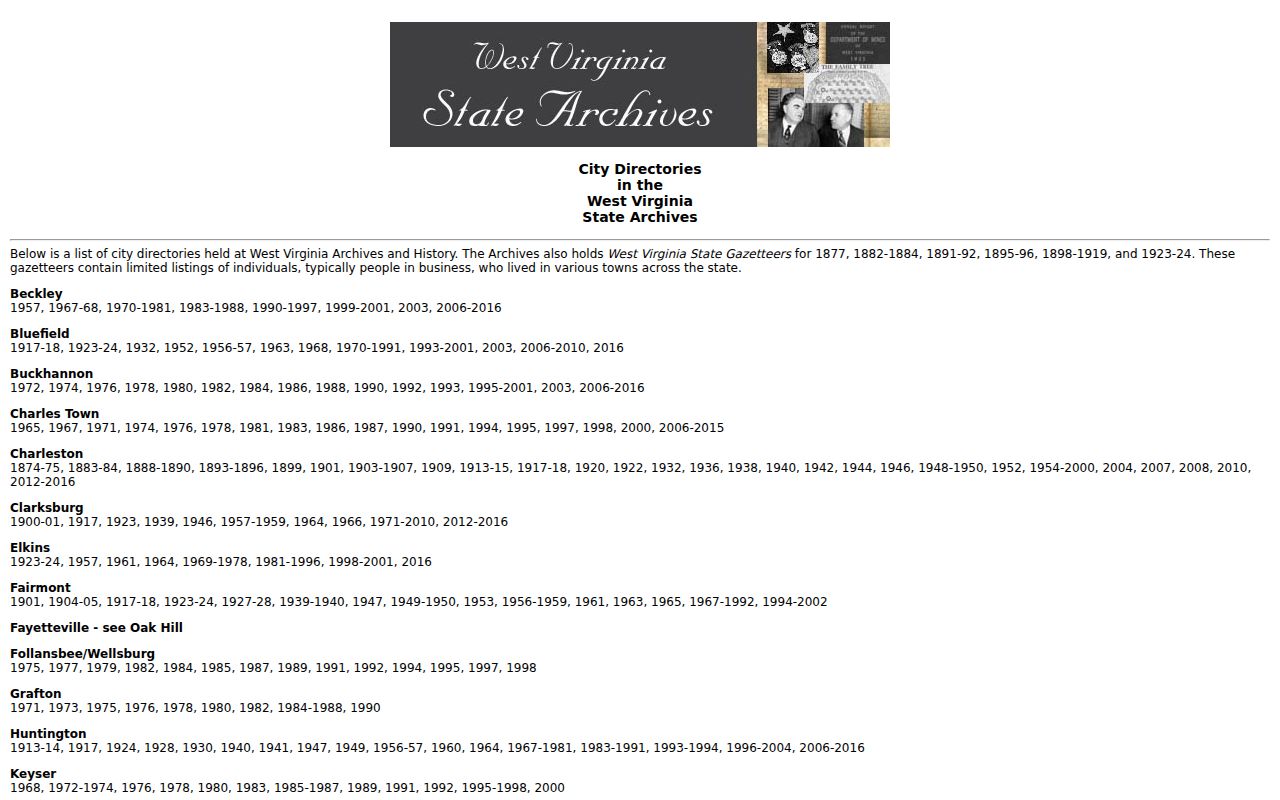
The year list prevents a search from drifting into an edition the institution does not claim to hold.
Cabell County Directory History Room
The Cabell County Public Library local-history service is the practical in-county route. The main branch is at 455 9th Street in Huntington and can be reached at 304-528-5700 or circulation@cabellcountylib.org. The James E. Casto Local History Room focuses on Cabell County and nearby Lawrence County, Ohio, and Boyd County, Kentucky, which fits the area's cross-river family history.
Its materials include Brittle Books, local titles and magazines, microfilm, yearbooks, postcards, and web databases. The library system also has branches in Barboursville, Cox Landing, Gallaher Village, Guyandotte, Milton, Salt Rock, and West Huntington. Ask for a specific surname, place, source type, and date range. A focused request is much more likely to match the published service than a request for everyone bearing one surname.
The library's public local-history route is shown here before any name request is made.
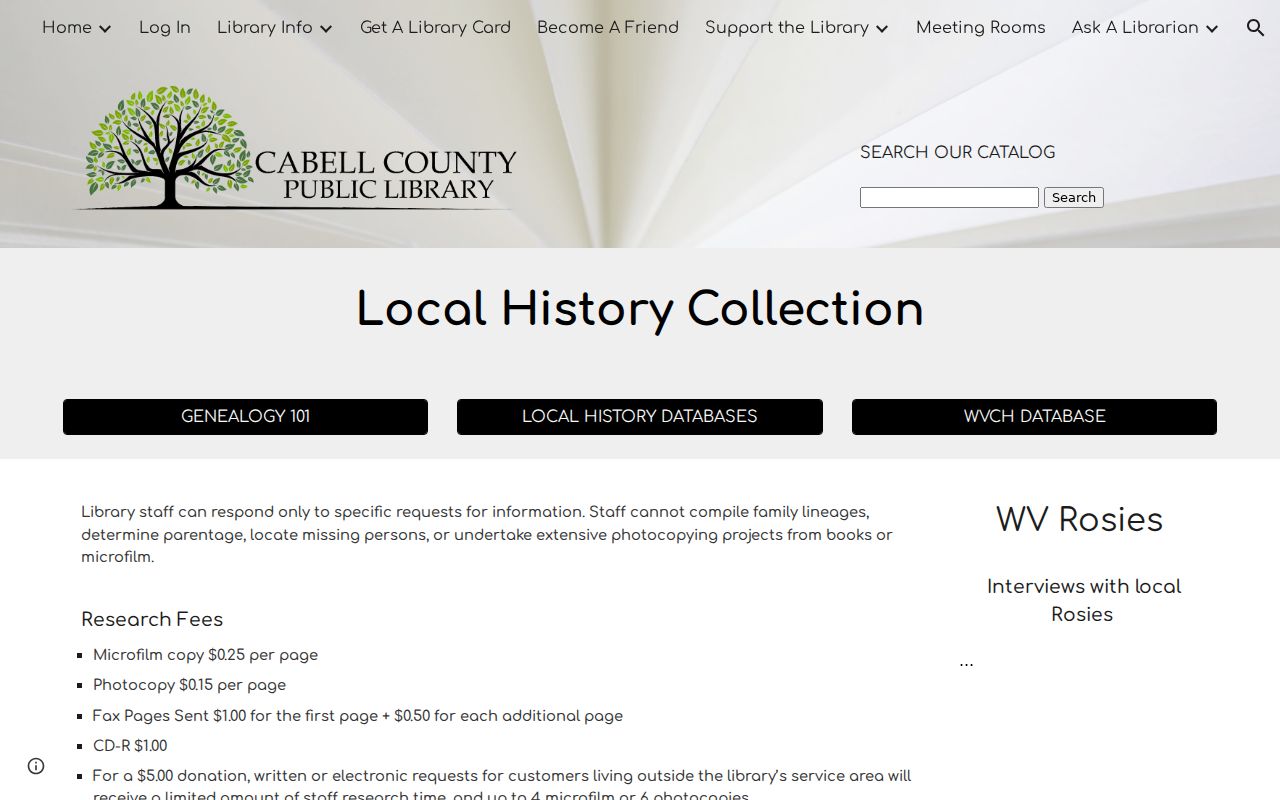
The service rules on that page help set the date and item details staff will need.
Read a Cabell County Directory Entry
The 1891–92 Potts & Cammack volume shows how compact a historical entry can be. Phrases such as “res 1011 6th av” place a named person at a printed residence address, while “res same” ties the residence to an address already stated in the entry. Copy the line as printed before expanding it. OCR may omit letters, punctuation, or text at a column edge.
| Name | Printed surname, given name or initials, which may not match a later record |
|---|---|
| Work line | Occupation or business address when the edition supplies it |
| Residence | House number and street, often introduced by “res” |
| Household mark | “rms,” “bds,” “Mrs.,” or “Miss,” interpreted through that edition's key |
| Page context | Nearby alphabetical or street entries that help detect an OCR split |
- Criss-cross directory
- A volume or section ordered by address rather than surname. No official Cabell run was confirmed.
- Householder index
- An address-based list of the person the publisher chose to identify for a household.
- Abbreviation key
- The edition's own explanation of shortened words and symbols. Save it before expanding any entry.
A directory does not reliably show ownership, age, race, complete household membership, or continued residence. State only that the named person appears at the printed address in that edition, then test the fact against census, deed, map, or newspaper evidence.
Huntington's 1891 Directory
The free Huntington 1891–92 directory scan is attributed to Potts & Cammack and printed by Hamilton Print Co. Its catalog describes 174 scanned pages and 135 physical pages. Beyond the alphabetical list, it contains classified businesses, a city guide, street information, and period advertisements. Those sections explain many names and address forms that an alphabetical search alone misses.
Search the OCR to locate a likely page, then read the image. A truncated “Brown” line or merged column is not a safe transcription. Save the page number, edition title, printed spelling, and exact phrase. The scan's public catalog appears below.
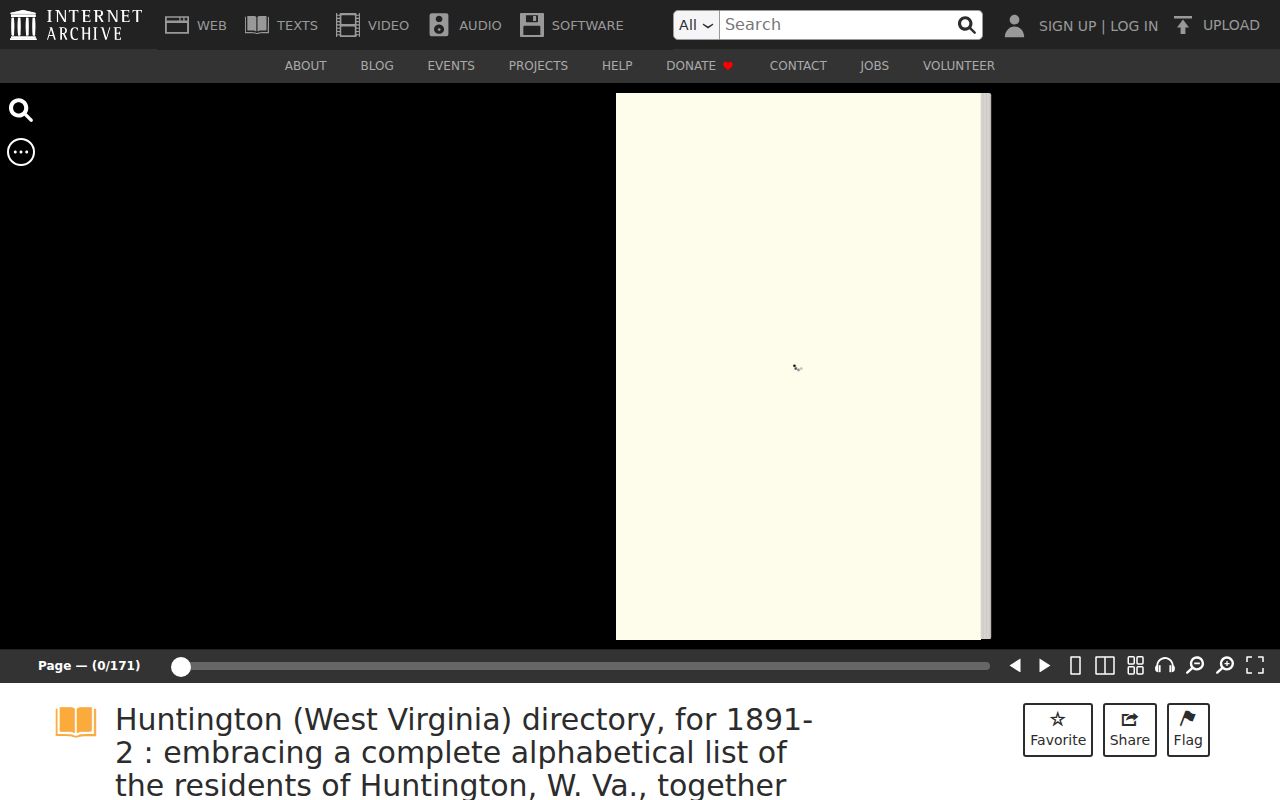
The page viewer, not the extracted OCR, should control the final citation.
Cabell County Directories and Old Places
Historical place names can divide one family trail. Central City was separate from 1893 to 1909, then became part of Huntington. Guyandotte appears in the 1889 Sanborn set and remains a Huntington neighborhood name. Search each historic label and the modern Huntington label. A record cataloged only under “Huntington” may miss a period title, while a search limited to “Central City” may miss later directory years.
Huntington's planned grid also changes how the pages read. A directory may print “3d av,” “6th av,” or “14th St W.” Copy the old form and add a normalized form in a separate field. Do not claim an official renumbering event: the research found no countywide renumbering year. The safest crosswalk pairs the directory with a period Sanborn sheet and the 1891 Huntington Transit Book at Marshall Special Collections.
Note: A historical city or neighborhood label should remain in the citation even when today's postal label is Huntington.
Cabell County Directory Companion Records
Directories gain value when paired with records created for another purpose. The Library of Congress Sanborn collection has Huntington editions from 1884, 1889, 1893, 1898, 1904, 1931/1950, and 1954. A sheet can show a building footprint, street number, institution, material, or neighborhood change. It cannot identify a current occupant.
Marshall University Special Collections holds the 1891 Huntington Transit Book plus manuscripts, rare books, university archives, and audio material. Many items are not fully indexed. A useful request gives the surname, community, years, source type, and asks staff for the collection and folder citation. The public contact is 304-696-2343 and speccoll@marshall.edu.
WVU's Cabell subject guide adds land records from 1806–1867, county census returns, an 1849 sheriff summons, highway maps, family papers, and Mud River Baptist Church minutes from 1818–1982. A finding aid is a discovery tool. Inspect the folder or image before claiming a person appears.
Cabell County Directory Research Timeline
The county's library and directory sources grew alongside Huntington. These dates help place a volume in its record setting without implying a continuous annual run.
| Year | Directory or access milestone |
|---|---|
| 1871 | Huntington was founded with its planned rail-linked grid. |
| 1891–92 | Potts & Cammack published the early digitized directory. |
| 1902 | The local library system began in a downtown room. |
| 1904 | A Carnegie library building opened. |
| 1980–82 | A new library facility opened, followed by early automation and catalog work. |
The milestones explain why older directories, microfilm, and yearbooks may be available through local staff even when they are absent from a web catalog.
Trace Family Through Cabell County Directories
A city directory fills some years between federal census releases. It works best as a sequence of dated sightings, not as one final biography. Begin with a volume close to a known event and move one edition at a time.
- Find the earliest sure entry and save the edition, page, printed name, and full line.
- Move forward through the Archives holdings, noting address and work changes without filling missing years.
- Check the nearest released federal census, including the 1950 Cabell County census, for household context.
- Compare the address with a Sanborn sheet or deed when a street form changes.
- Use a vital record, probate record, cemetery source, or dated obituary to explain the end of the sequence.
A person who disappears may have moved, died, been omitted, changed names, or lived outside the publisher's coverage. The library obituary service requires a complete death date. If the exact day is unknown, staff search one newspaper across a five-day span, and general newspaper article requests require the exact publication date. Establish the date first through a vital, probate, cemetery, or family source.
For selected historical birth, death, and marriage leads, use the West Virginia Archives vital index. An index entry is not a certified record and does not prove residence. Keep “born in Cabell,” “died in Cabell,” “recorded in Cabell,” and “listed at a Cabell address” as separate claims.
When a surname is common, use the directory's work line, spouse notation, and exact street form as a cluster rather than matching on the name alone. Carry that cluster into the next volume and the nearest census. If the entry says Central City or Guyandotte, repeat the historical label in the search before trying modern Huntington. The label change can explain a missing result without assuming that the family moved.
For an item not online, contact the Cabell County Public Library with the edition year and surname, or Marshall Special Collections with the collection type and date span. Ask for a scan or citation to the actual page. A catalog record confirms a holding, while the page image supplies the evidence needed for a careful Cabell city directory transcription.