
Cabell County Previous-Resident Records
No single Cabell County roll names everyone who lived at one address. Begin with the era in question. Current parcel geography and recorded deeds establish the property thread. Huntington directories add dated names and street forms, and the released federal census can show a household. Sanborn maps explain the building and block, but do not identify a current occupant. The Cabell County Public Library and state archives provide the main fallback when a source is not fully searchable online.
| Source | Documented span | Where to use it | What it contributes |
|---|---|---|---|
| Cabell County Clerk index | Portal date control begins at 1900; exact online span is not published | Public index, then clerk or archives | Grantor, grantee, instrument, date, book/page, and legal description |
| Huntington city directories | Archives runs from 1913–14 through 2016, with gaps | West Virginia Archives and library | Dated residents, addresses, and household clues |
| 1891–92 directory | One early volume | Internet Archive scan | Printed names, “res” entries, businesses, and period street forms |
| Federal census | Public schedules through 1950 under the 72-year rule | National Archives search | Households at a released census date |
| Sanborn maps | Cabell-area editions from 1884 through 1954 | Library of Congress | Building footprint, street number, use, and block context |
For a recent transfer, start with the assessor and clerk. For the twentieth century, move quickly to directories and census schedules. Early Huntington work may need the directory, transit book, and Sanborn map together. The exact online start for each clerk category was not published, and no official countywide reverse-directory run was found. That makes the clerk counter, the library’s local-history service, and archival research real parts of the access chain, not last-resort extras.
Cabell County Address Snapshots
A historical address is not a timeless fact. The 1891–92 Potts & Cammack directory uses short forms such as “res,” “rms,” “bds,” and “3d av.” Keep the printed spelling and page reference before expanding an abbreviation. Optical character recognition can omit letters or join columns, so the scanned page controls over searchable text. An entry proves only what that edition printed.
The official Archives holdings are extensive but not annual. Listed Huntington runs include 1913–14, 1917, 1924, 1928, 1930, 1940, 1941, 1947, 1949, 1956–57, 1960, 1964, 1967–81, 1983–91, 1993–94, 1996–2004, and 2006–16. A missing year is not proof that the house stood empty. Use the nearest editions and describe the gap.
For the collections and abbreviation practice in depth, use the Cabell County city directory material. Previous-resident research uses each volume as one rung in an address trail.
Note: No official source confirmed a countywide address-renumbering date, so any old-to-new address match must remain a sourced research inference.
Cabell County Previous Residents Library
The Cabell County Public Library local-history service is the practical route for directory, yearbook, postcard, and obituary work that a web index cannot finish. The James E. Casto Local History Room focuses on Cabell County and nearby parts of Ohio and Kentucky. The main branch is at 455 9th Street in Huntington, and the published phone is 304-528-5700.
Give staff a person, approximate place, source type, and narrow date range. Obituary help has stricter inputs. The library requires a complete death date; when the day is uncertain, staff search one newspaper over a five-day span. The Herald-Dispatch is not indexed there, and article requests need an exact publication date. Establish the date through a death record, probate entry, cemetery source, or family record first.
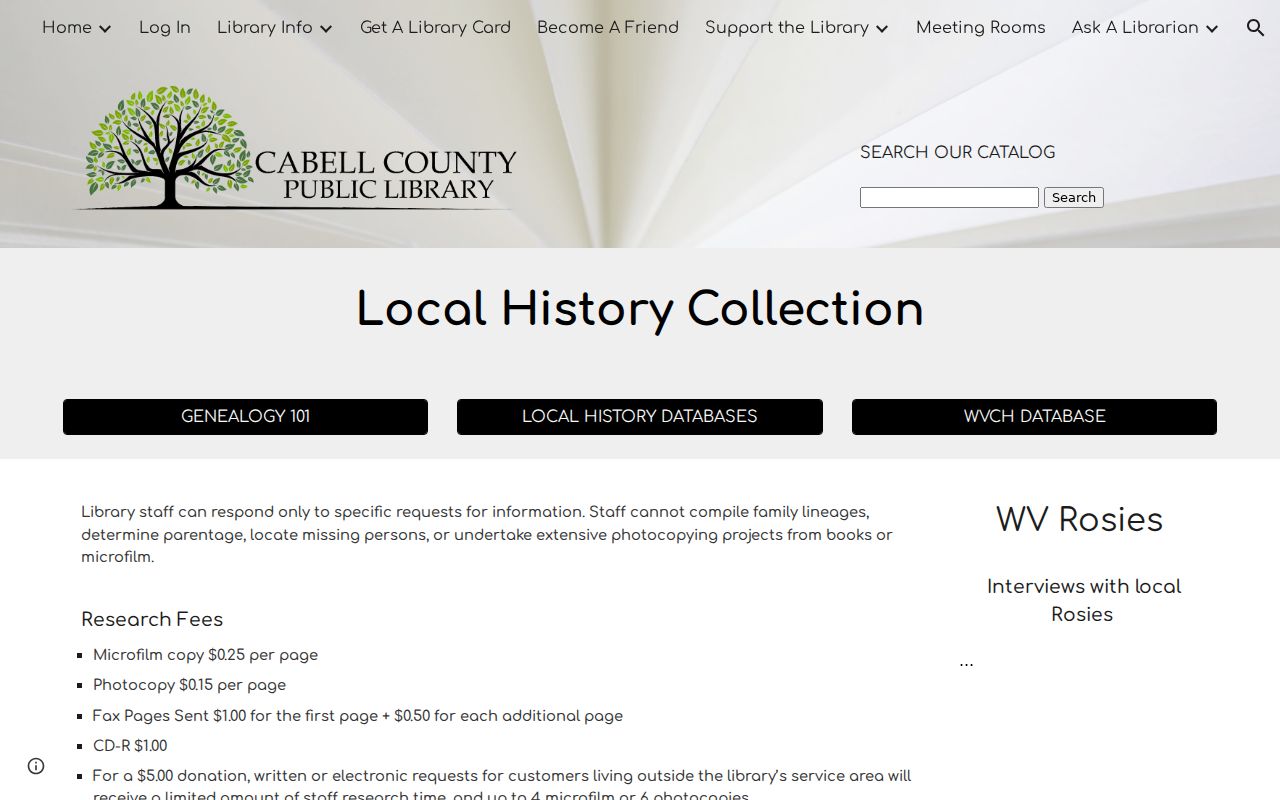
The library’s public service page is shown in this capture.
Walk Cabell County Records Backward
The Cabell County Assessor supplies parcel geography, while the County Clerk supplies indexed instruments. Connect them with the district, map, parcel, subparcel, and legal description. Names alone are weak links because a party may be a trustee, executor, attorney-in-fact, lien party, grantor, or grantee. Label the role shown in each document.
- Locate the parcel through the Cabell County Assessor. Save its identifiers and displayed situs address.
- Use the Cabell County Clerk index to find the current acquisition deed. Record the instrument date and book/page.
- Read the deed’s legal description and seller. Search that seller as a grantee to locate the earlier acquisition.
- Repeat the grantee-to-grantor link. Check survivor deeds, certificates of transfer, corrective deeds, and estate records when a normal sale is absent.
- When the online index or image ends, request the book and page through the clerk or an archive instead of guessing the next owner.
- Grantor and grantee
- The grantor transfers an interest; the grantee receives it.
- Chain of title
- The linked sequence of recorded transfers for the same property.
- Legal description
- The recorded lot, boundary, or tract description. It can stay stable when a mailing address changes.
- Situs address
- The property’s physical address in an assessment record, which may differ from a tax mailing address.
The clerk portal allows date, name, role, book/page, instrument, and description searching. Result columns include date, document, book/page, pages, name, cross date, and instrument. Search access appears free, but login and image controls exist. Since exact category coverage and image rules were not published, cite an index result as an index unless the underlying image was reviewed.
Crosswalk Cabell County Addresses
Huntington’s planned grid makes many old references readable, but historical place labels can split one trail. Central City was a separate city from 1893 to 1909 before annexation into Huntington. Guyandotte also appears as its own label in early Sanborn editions and survives in present community language. Search both the historical label and modern Huntington form.
A strong crosswalk has three parts. First, copy the exact directory form, including “West” suffixes and forms such as “3d av.” Next, consult the 1891 Huntington Transit Book at Marshall Special Collections for street sequence. Then place the block on the closest Sanborn edition. Compare that result with the modern assessor map and the clerk’s legal description.
This method can explain an apparent address conflict without inventing a renumbering event. Sanborn sheets show built form and historic labels, not previous residents by themselves. Record the edition and sheet number so another researcher can check the same evidence.
Maps Separate Lots From Lives
The Cabell tax-map index organizes static sheets by district and map number, with current and prior-year links. Its district labels include Barboursville, Grant, Guyandotte, Gideon, Huntington Guyandotte, Kyle, Mc Comas, Milton, and Union. A map can preserve the parcel’s shape and number across a confusing street label.
Assessment maps are not surveys. The sample Kyle sheet shows parcel numbers, original lots, roads, water, rail lines, and government boundaries, but the Assessor disclaims a field-verified boundary. Use the map to identify the likely parcel. Use the deed to test title history. Use a directory or census to test who lived there.
Note: A tax class, taxpayer name, or mailing address may support a lead, but none independently identifies the home’s occupant.
Cabell County Archive Records
Some Cabell County address trails predate useful city-directory coverage. The WVU Cabell County subject guide points to land records from 1806–1867, county census returns, an 1849 sheriff summons, highway maps, family papers, and Mud River Baptist Church minutes. These are finding aids. A collection description does not prove that a target person appears.
Marshall Special Collections also holds manuscripts, maps, rare books, and the Huntington Transit Book. Many materials are not fully indexed. Send the surname, community, approximate years, and desired record type, then ask for a collection and folder citation. That request is more useful than asking an archive to find every previous resident at a modern address.
The land-record finding aid can lead to an owner, acreage, land entry, survey fee, warrant, or page reference. Church minutes may preserve membership, subscriptions, repairs, and correspondence tied to a community. Those details can help distinguish two families with the same surname, but only after the actual folder or image is read. Keep the archive citation beside each extracted fact. If the finding aid names a collection but no digitized item, contact the repository or plan an on-site review rather than turning the collection summary into evidence about a household.
Match Cabell County Previous Residents
Deeds tell only the ownership side. To trace previous residents, pair a directory snapshot with a released census schedule and then seek an obituary or probate record. A directory might name one householder, boarder, or roomer. The census may show a larger household at its enumeration date. Neither should be stretched beyond the date and fields it supplies.
- Choose a verified address form from the deed, period map, or directory.
- Find the closest directory edition and save its page, spelling, abbreviation, and printed address.
- Search the nearest released census year by name, county, place, or enumeration district, then inspect the actual schedule.
- Compare household names without assuming every difference marks a move. Death, marriage, absence, and directory omissions can alter the list.
- Use probate, archival vital indexes, or an obituary request to follow a person after the last address entry.
The West Virginia Archives vital index can supply selected birth, death, and marriage leads. An index is not a certified record and is not complete for every event. Recent certificates have eligibility and identification limits; state law releases births after 100 years and death, marriage, divorce, and fetal-death records after 50 years, subject to stated exceptions.
Lawful use. Cabell County previous-resident research supports house history, genealogy, and estate work. Never use historical address clues to track, harass, or harm a living person.